Radiometry deals with the measurement and study of electromagnetic radiation, specifically focusing on the properties and behavior of light. It involves quantifying various radiometric quantities associated with the optical portion of electromagnetic radiation, which is further divided into ultraviolet, visible, and infrared.
Radiometry is important because it provides quantitative information about light and its interaction with matter. By accurately measuring these radiometric quantities, scientists can understand the physical characteristics and behaviors of light in different environments.
Radiometric Quantities
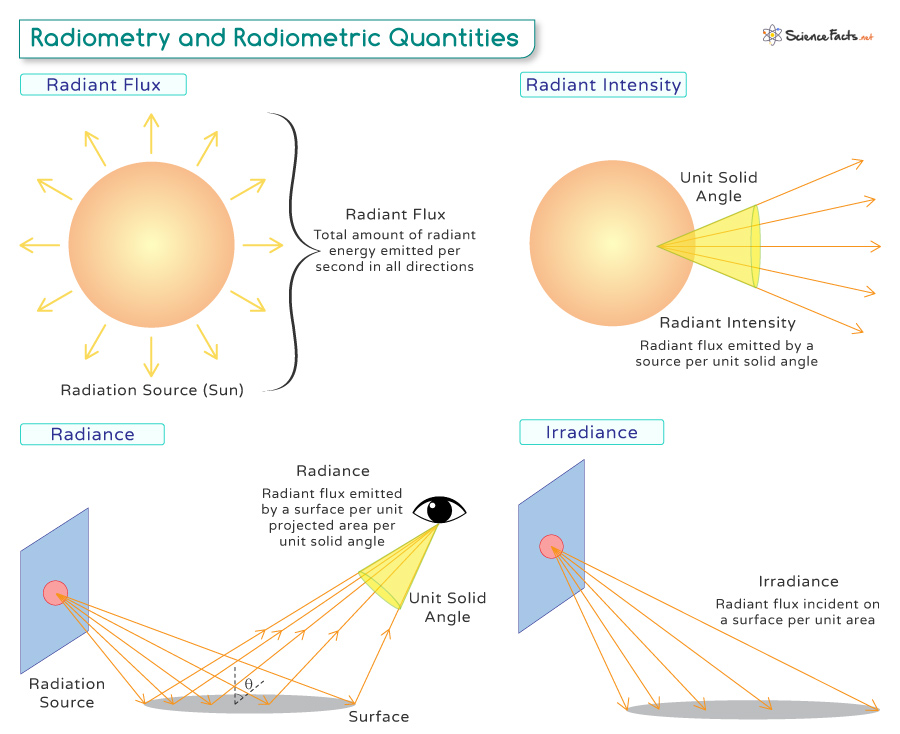
Radiometric quantities play a crucial role in accurately quantifying and analyzing various forms of radiant energy. The table below discusses these quantities.
Applications
Radiometry is crucial in various fields, such as:
- Astronomy and Astrophysics : Radiometry helps physicists analyze starlight or other celestial emissions to determine their composition and physical properties.
- Meteorology : Weather forecasting or climate studies utilize radiometry to measure solar radiation reaching the Earth’s surface or quantify atmospheric phenomena such as cloud cover.
- Photography and Cinematography : Proper exposure settings rely on accurately measuring the amount of light falling on a subject.
- Others : It is used across industries like agriculture to optimize crop growth using artificial lighting, aerospace for thermal analysis, telecommunications, and fiber optics, among many others.
- References Radiometry and Photometry – Ossila.com Radiometry – Rp-photonics.com Introduction to Radiometry and Photometry – Andor.oxinst.com Radiometry – Cs.cornell.edu Radiometry and Photometry FAQ – Wp.optics.arizona.edu Radiometry and Photometry – Depts.washington.edu
Article was last reviewed on Wednesday, June 5, 2024


