Photosynthesis and cellular respiration are the two essential life processes on Earth that help living organisms survive. They are interrelated such that the products of one process are the reactants of the other and thus work in a cycle.
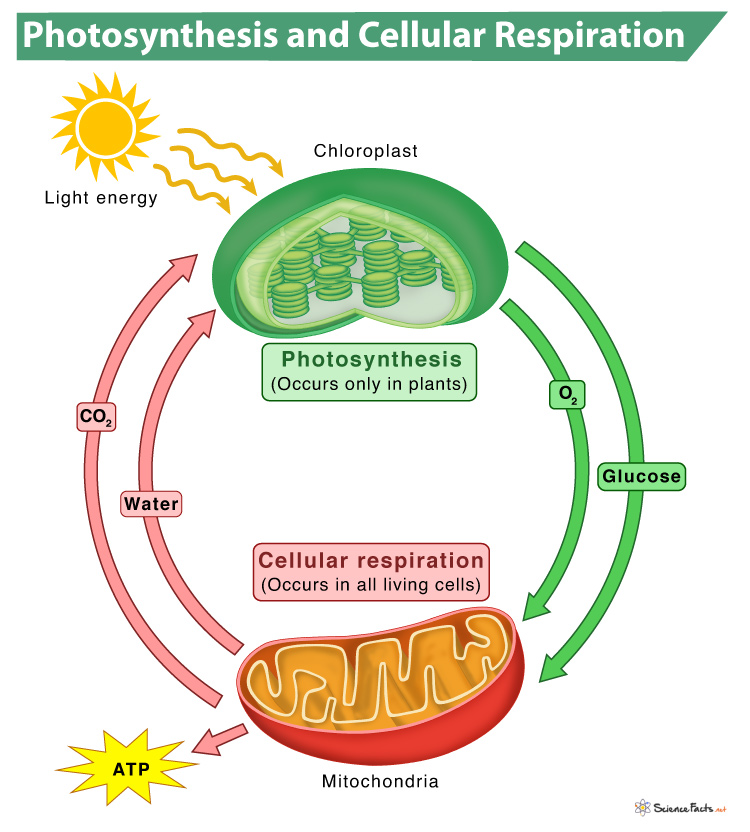
Photosynthesis and Cellular Respiration
How are Photosynthesis and Cellular Respiration Related
Photosynthesis is a process by which green plants and algae make food in the form of carbohydrates (C 6 H 12 O 6 ) using water (H 2 O), carbon dioxide (CO 2 ), and chlorophyll in the presence of sunlight as the energy source. Water and oxygen are produced as byproducts. In contrast, cellular respiration breaks down carbohydrates produced through photosynthesis and uses oxygen to produce energy and carbon dioxide. The carbon dioxide is again utilized during photosynthesis to continue the cycle.
The relationship between photosynthesis and cellular respiration can be best understood using the chemical equations given below:
Equations
Photosynthesis: 6CO 2 + 12H 2 O + sunlight → C 6 H 12 O 6 + 6O 2 + 6H 2 O
Cellular Respiration: C 6 H 12 O 6 + 6O 2 → 6CO 2 + 6H 2 O + ATP (energy)
Thus, photosynthesis is just the opposite process of cellular respiration, and they work in a circle.
Both processes are essential parts of the carbon cycle. While cellular respiration produces carbon dioxide in the environment, photosynthesis removes carbon dioxide from the atmosphere. The exchange of CO 2 and O 2 during photosynthesis and cellular respiration helps recycle carbon dioxide in the biosphere. It keeps oxygen and carbon dioxide levels stable.
Compare and Contrast between Photosynthesis and Cellular Respiration
Although interrelated in nature, photosynthesis and cellular respiration are different in many ways.
How are Photosynthesis and Cellular Respiration Different
How are Photosynthesis and Cellular Respiration Similar
Despite the two processes being opposite, they share some similarities.
- They involve multiple complex steps and many same molecules such as oxygen (O 2 ), carbon dioxide (CO 2 ), water (H 2 O), glucose (C 6 H 12 O 6 ), and adenosine triphosphate (ATP)
- Exchange of gases
- Series of redox reactions involving enzymes
Summary
Photosynthesis and cellular respiration are the two basic metabolic processes that work together to drive all cellular activities. All the primary producers in a food chain produce food by photosynthesis. In contrast, cellular respiration occurs in all living organisms on Earth. Food gets oxidized to obtain energy as ATP, which powers almost all the cellular processes. Also, the products of one process are utilized by another, creating a balance in nature.
Ans . Oxygen is released as a byproduct in photosynthesis, whereas, in cellular respiration, oxygen helps to oxidize glucose to liberate energy.
- References Just Breathe: An Introduction to Photosynthesis and Cellular Respiration – Orise.orau.gov Difference Between Photosynthesis and Cellular Respiration – Researchgate.net Steps of cellular respiration – Khanacademy.org Cellular Respiration and Photosynthesis – Flexbooks.ck12.org
Article was last reviewed on Wednesday, August 31, 2022
