The monocot stems are stems of monocot plants. They have scattered vascular bundles of xylem and phloem, surrounded by a bundle sheath of sclerenchyma cells. The monocot stems have other significant features: lack of trichomes (epidermal hairs), medullary rays, cortex or pith, and a stele. Also, the hypodermis consists of sclerenchyma cells.
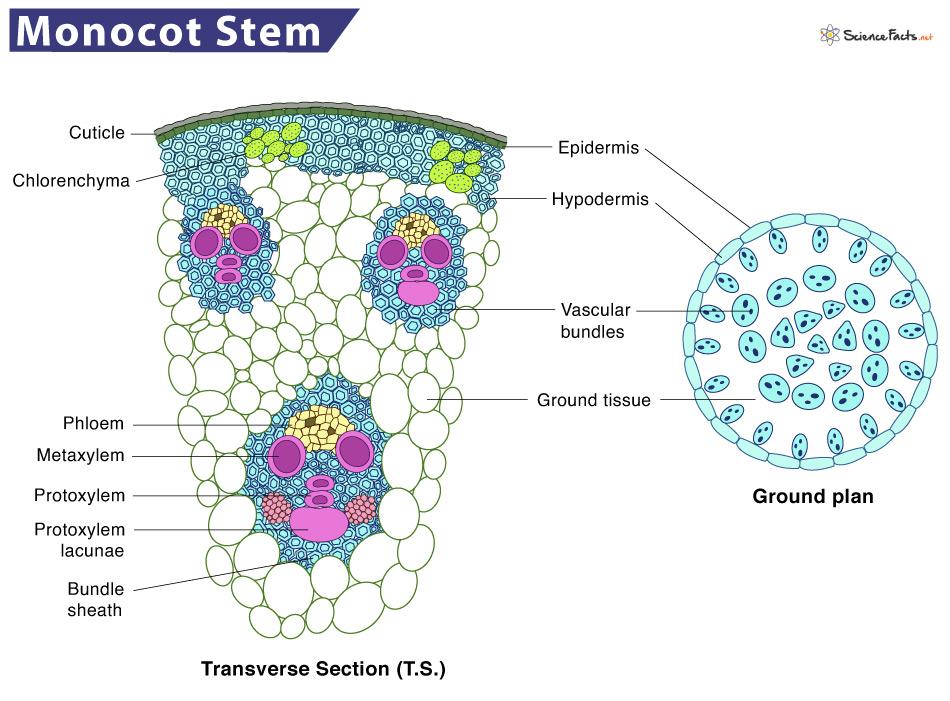
Monocot Stem
The dicot stems are stems of dicot plants. They are arranged concentrically, one above the other. The vascular bundles of dicot stems are arranged in a ring without a bundle sheath. However, parenchyma cells surround each vascular bundle in the dicot stem. The hypodermis of dicot stems is made of collenchymas cells. They have other significant features such as trichomes in the epidermis, prominent cortex, and stele. In addition, dicot stems show secondary thickening, which leads to secondary growth.
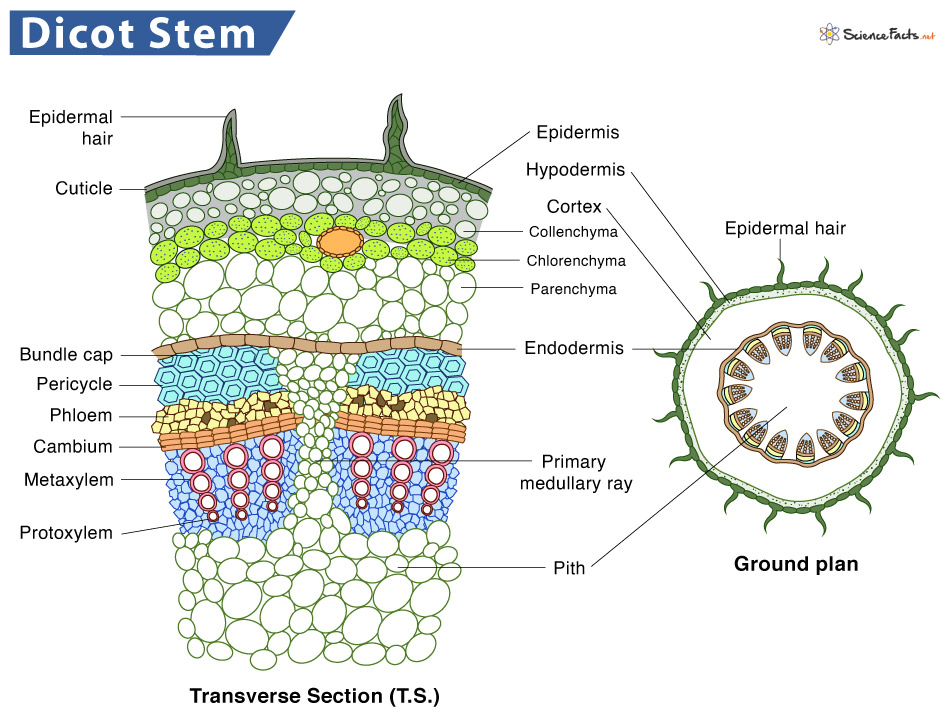
Dicot Stem
Let us discuss the structural and functional similarities in monocot and dicot plants.
Similarities
Structure
The internal structure or anatomy of the stems of monocot and dicot plants has the following parts in common.
Epidermis
- It is the single, outermost layer arranged compactly without intercellular spaces.
- The epidermis cells lack chlorophyll
- Outside the epidermis is a layer of the cuticle that protects the epidermis and tissues lying underneath
- It contains stomata for the gas exchange
Cortex
- It is divided into different sections, but the region covered differs widely between monocot and dicots stems.
- The hypodermis is present immediately below the epidermis, which provides additional support to the epidermis. It is a thick multicellular layer composed of collenchyma tissue. The cells of this region contain chlorophyll and thus can prepare food for the plant.
Ground Tissue
- It is a mass of parenchymatous cells extending to the hypodermis center.
- The cells are spherical, thin-walled, and loosely organized with intercellular spaces.
Pericycle
- It is the tissue found between the endodermis and the vascular bundles.
- The cells are sclerenchymatous, which has the shape of semilunar patches above the vascular bundles.
Vascular Bundles
- They are of conjoint and collateral type surrounded by parenchyma cells
- They are limited in number and have a uniform size. Each bundle consists of a patch of xylem and phloem
- Xylem consists of both protoxylem and metaxylem
- The quantity, arrangement, and components of vascular bundles vary widely between monocot and dicots stems
Pith
- The cells are parenchymatous and appear like medullary rays around the arterial bundles.
- The cells might be spherical or polygonal, with or without any intercellular spaces.
- They store food and aid in transporting food and water between the bundles.
Functions
Both monocot and dicot stems perform the same essential functions that are discussed below:
- It is the central axis of the plant that supports other parts such as leaves, branches, flowers, and fruits
- Transports food, water, and minerals throughout the plant body
- Young, green stem having pigments chlorophyll prepares food by photosynthesis
- Stores a large number of food particles like starch and other nutrients
- The meristem tissue of the stem divides to form new tissues, thus helping the plant to grow
- The stomata in the stem helps in transpiration
- Modified stems like cactus help to store water and food, prevent water loss, and thus in their survival in the desert
Although monocot and dicot stems have the following structures in common, there are several differences. They are discussed below.
Difference between Monocot and Dicot Stem
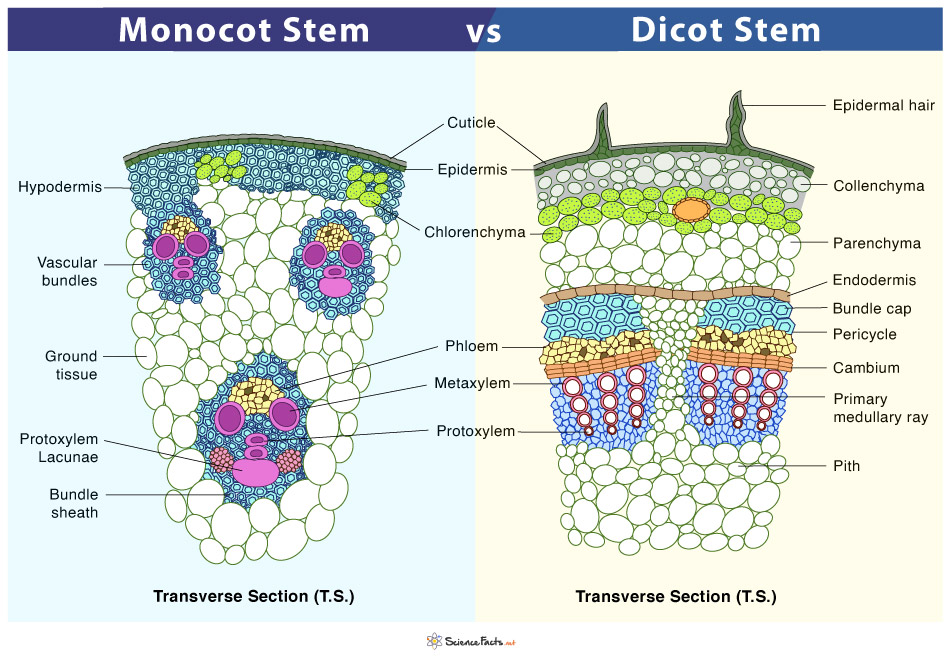
Monocot vs Dicot Stem
- References Monocot and Dicot Stems – Visiblebody.com Plants and Their Structure – Biologie.uni-hamburg.de Monocot vs Dicot Stem – Holganix.com Differences Between Monocot stem and Dicot stem – Longdom.org
Article was last reviewed on Thursday, February 2, 2023
