Historically flowering plants (angiosperms) are classified into two broad types or groups – monocotyledons or monocots and dicotyledons or dicots.
The classification of angiosperms was first published by John Ray in 1682 and later by the botanist Antoine Laurent de Jussieu in 1789.
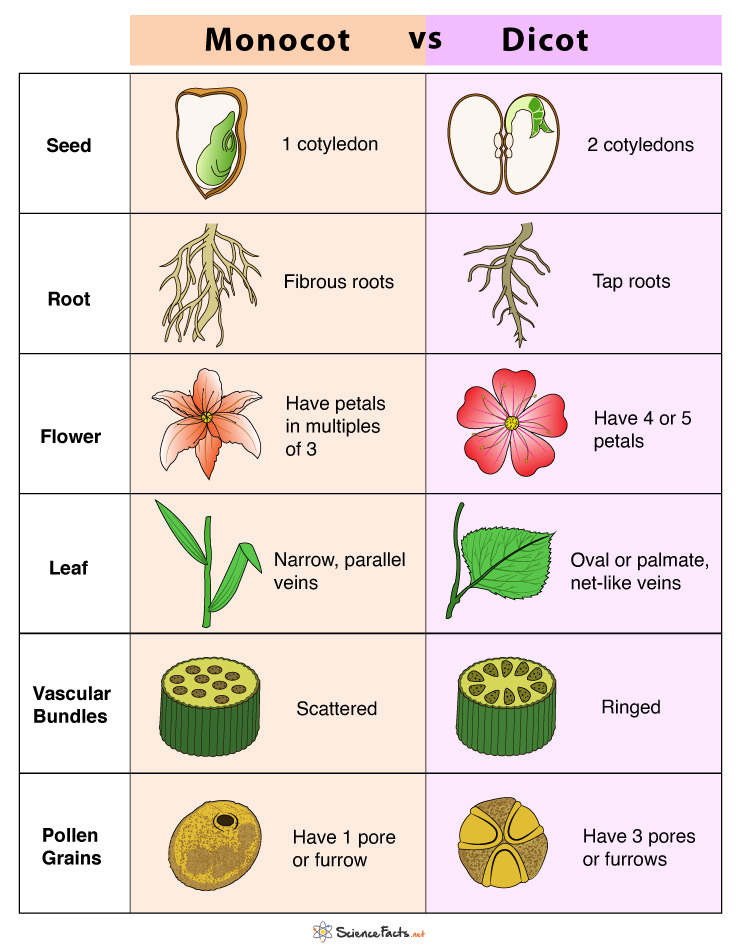
Monocot vs Dicot
Monocots and Dicots
Monocots are flowering plants having seeds with a single cotyledon or embryonic leaf. There are as many as 60,000 plant species found worldwide. The orchids (Family: Orchidaceae) and the grasses (Family: Poaceae) form the largest and the second most abundant group, respectively. All monocots share a common evolutionary history, thus are a monophyletic group.
Dicots are flowering plants having seeds with two cotyledons or embryonic leaves. They are the largest group within angiosperms consisting of about 200,000 species. Unlike monocots, dicots are not plants arising from a single ancestor but have evolved from different lineages. Thus dicots are paraphyletic.
What Is the Difference between Monocot and Dicot
Monocots and dicots differ in four distinct structural features: seeds, leaves, stems, roots, and flowers.
However, the difference starts from the very beginning of their life cycle in the form of a seed. Within the seed lies the embryo or the baby plant. At the start of their life cycle, the difference in their embryo leads each plant to develop vast differences.
The key differences between them are presented below in tabular form.
Similarities
Angiosperms or flowering plants
Vascular plants using xylem and phloem to move water and nutrients throughout the plant
Have stamens with four (two pairs) of pollen sacs, and the carpel is closed.
Male gametophyte is made of three cells, and female gametophyte consists of seven cells with eight nuclei.
References Monocots versus Dicots – Ib.bioninja.com.au Monocots versus Dicots – Ucmp.berkeley.edu Dicot or Monocot – Diffen.com Monocots vs. Dicots Explained – Untamedscience.com
Article was last reviewed on Friday, February 3, 2023
