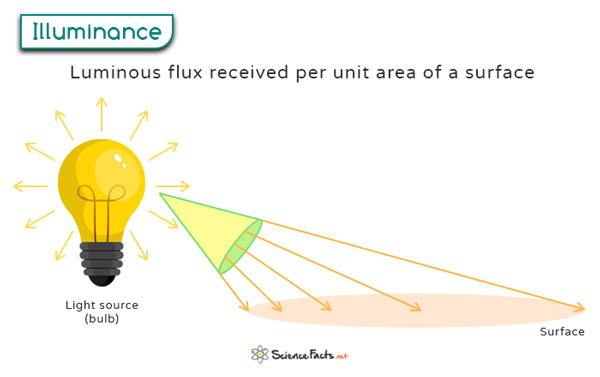
Illuminance serves as the quantitative backbone for understanding how light interacts with surfaces. It represents the quantity of light falling onto a given surface area. Conceptually, it signifies the brightness that an observer would perceive on a surface under the influence of incident light. Illuminance is not merely about the surface’s inherent properties but rather the amount of light it receives.
Formula
Mathematically, illuminance (E) is expressed as the ratio of luminous flux (Φ) incident onto a surface to the surface area (A) receiving that flux. This core formula can be articulated as follows:
Where:
– ∅ is luminous flux (in lumens or lm)
– A is the surface area (in square meters or m²).
This formula elucidates how the amount of light energy falling onto a surface is distributed over the given area, quantifying the intensity of light that the surface receives.
Unit
SI System : Lux (lx) is the commonly used unit across diverse fields. It represents the light intensity that falls on a surface per unit area. One lux equals one lumen per square meter.
1 lx = 1 lm/m²
CGS system : Illuminance is measured in the unit known as phot, which is equivalent to 10,000 lux.
1 phot = 10,000 lux
Another popular unit in the United States is foot-candles (fc), which are defined as one lumen per square foot.
1 fc = 1 lm/ft 2 = 10.76 lux
Examples
Some practical examples of illuminance values are:
- Indoor office spaces commonly aim for illuminance levels between 300 to 500 lux to ensure comfortable working conditions without causing glare or visual discomfort.
- Public outdoor areas require higher illuminance, often ranging from 10 to 20 lux for pedestrian pathways and up to hundreds of lux for sports stadiums or high-traffic zones.
Applications
Illuminance is essential in many different areas.
- Lighting Design: It helps designers design spaces well, helps scientists with their work, and makes things look better in various industries. It helps to decide where and how bright the lights should be to ensure everything is just right for what people are doing. Knowing about illuminance also helps save energy.
- Photography and Movies : It is essential in photography and movies, especially when creating great pictures or scenes. It helps photographers and choreographers set up the camera right and ensure everything looks bright and clear, ensuring pictures or videos look just how they should. It makes the moviegoing experience better for everyone.
Luminance vs. Illuminance
Luminance and illuminance, often intertwined but inherently distinct, can be understood from the table below:
- References Understanding Illuminance: What is in a Lux? – Allaboutcircuits.com Illuminance vs. luminance – What Is the Difference? – Electronicshub.org Luminance and Illuminance – What is the Difference? – Faro.es Illuminance: Definition, Measurement, and Calculation – Erco.com
Article was last reviewed on Friday, June 7, 2024


