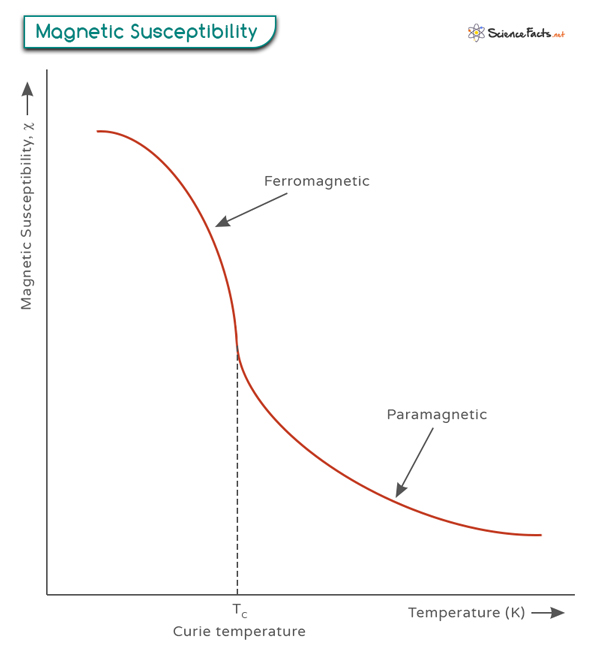
Curie temperature, also known as the Curie point, is a temperature that marks a significant phase transition in magnetic materials, particularly ferromagnetic substances. Below this temperature, these materials exhibit strong spontaneous magnetization, meaning they are naturally magnetic. Above this temperature, they lose their magnetization and become paramagnetic. It means they respond to an external magnetic field but do not retain their magnetization when the field is removed. Another way of saying it is that Curie temperature refers to the maximum temperature a material can reach before losing its magnetic properties.
Curie temperature derives its name from French physicist Pierre Curie, who demonstrated that magnetism ceased to exist at a specific critical temperature in the late 19 th century.
Significance
Elucidating the distinction between ferromagnetic and paramagnetic substances is necessary to fundamentally understand how magnetism is generated within a material. The magnetic force in a material is determined by its magnetic moment, which is essentially a dipole moment originating from the electrons’ spin and angular momentum. Each material possesses distinct arrangements of these intrinsic magnetic moments, and the way these moments align with one another is contingent upon temperature.
The magnetism of a material is solely evident when the magnetic moments align themselves in a specific configuration. Induced magnetism occurs when an assortment of disorganized magnetic moments are coerced into alignment by an applied magnetic field. As magnetic materials approach the Curie temperature, the alignment of their magnetic moments is forcibly disrupted. Consequently, as the operating temperature rises, nearing the material’s Curie temperature, the magnetic strength of the material diminishes due to the moments moving out of alignment. In general, magnets exhibit reduced strength when exposed to elevated temperatures.
Curie-Weiss Law
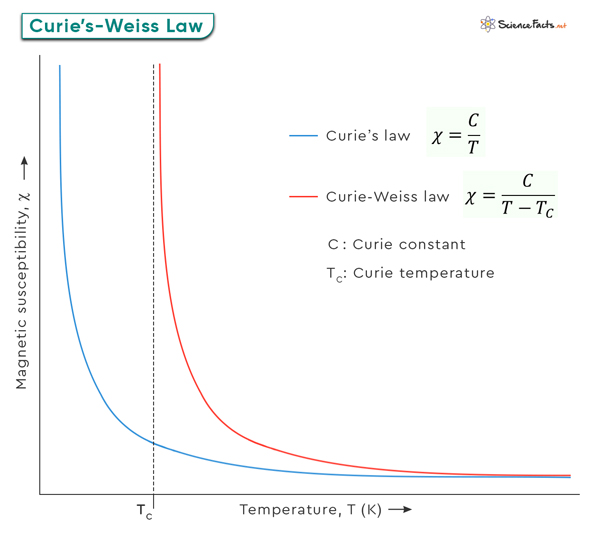
Pierre Weiss, a French physicist, was already a prominent figure in magnetism, particularly in studying ferromagnets. He collaborated with Curie to investigate the magnetic susceptibility of ferromagnets when subjected to a paramagnetic field above the Curie point. It led Weiss to formulate the Curie-Weiss Law, which accurately describes the magnetism of paramagnetic materials with a higher ratio of aligned moments than Curie’s original formulation.
Mathematically, the Curie-Weiss law is typically expressed as:
Where:
χ is the magnetic susceptibility of the material.
C is the Curie constant, a material-specific constant with the unit Aˑm -1 ˑKˑT -1 .
T is the absolute temperature (in Kelvin).
T C is the Curie temperature.
This law simplifies the complex behavior of actual paramagnetic materials. However, it provides a valuable approximation for understanding how their magnetic susceptibility changes with temperature. When T approaches T C , the magnetic susceptibility increases, indicating that the material becomes more responsive to an external magnetic field. When T is greater than T C , the material behaves as a paramagnet and becomes weakly magnetic.
Curie Temperature Values
The diverse magnetic materials possess distinct Curie temperatures, establishing varying maximum operating temperatures for each. Below is a table containing the Curie temperature values for different substances
Data Courtesy: Analyzing-testing.netzsch.com
- References Curie Temperature – Nhn.ou.edu Curie-Weiss Law – Eng.libretexts.org Magnetic Properties of Materials – Unlcms.unl.edu Curie’s Temperature of Magnets – Imt-inc.com
Article was last reviewed on Saturday, December 30, 2023


