What are Conservative and Non-conservative Forces
A conservative force is a force in which the work done moving a particle from one position to another depends on the initial and final positions and not on the path. It follows the law of conservation of energy. The sum of the potential and kinetic energies remains unchanged as the path progresses. The total work done by a conservative force around a closed path is zero.
An example of conservative force is the gravitational force of attraction between the Sun and the Earth.
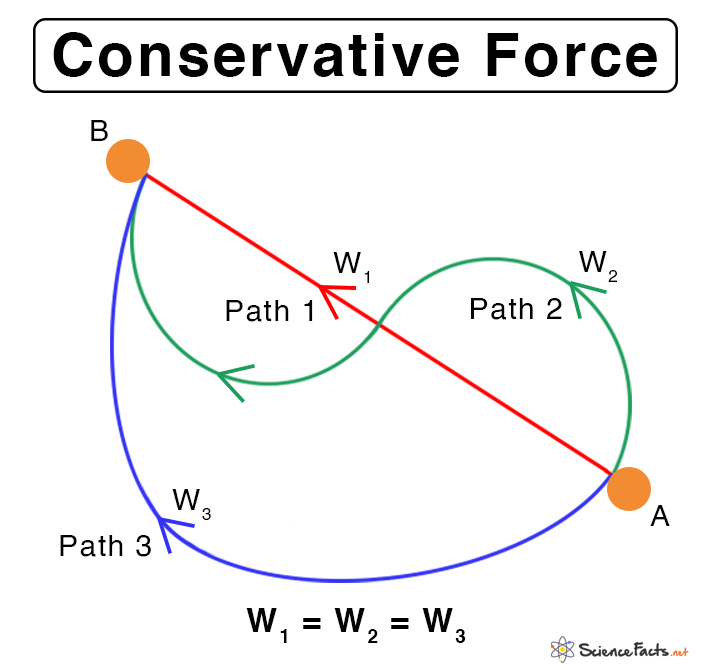
Conservative Force
Unlike a conservative force, a non-conservative force is one in which the work depends on the path taken from initial to final positions. It does not follow the law of conservation of energy. There is energy loss, primarily as heat, as the path progresses. The total mechanical energy in the final position is not the same as in the initial position.
An example of a non-conservative force is the friction between the wheel and the road during driving.
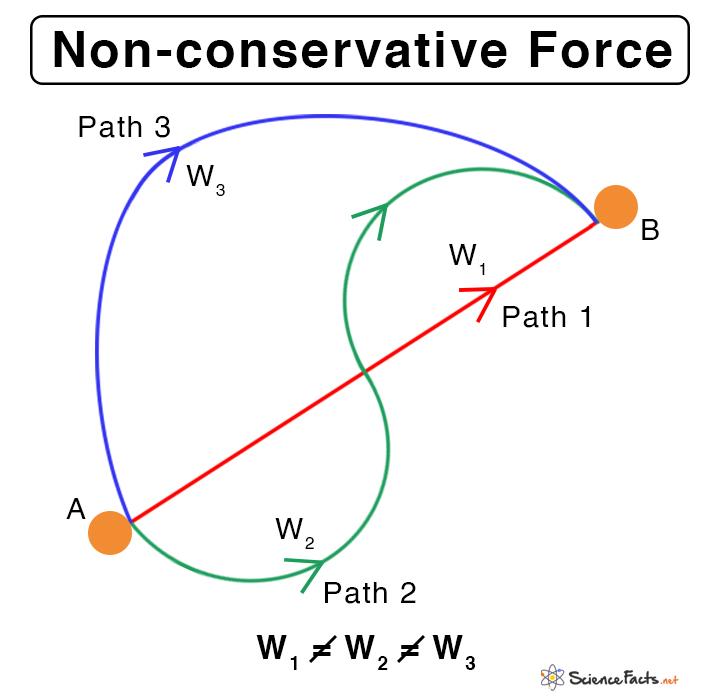
Non-Conservative Force
Conservative vs. Non-conservative Forces
The following table compares and contrasts the properties and examples of conservative and non-conservative forces.
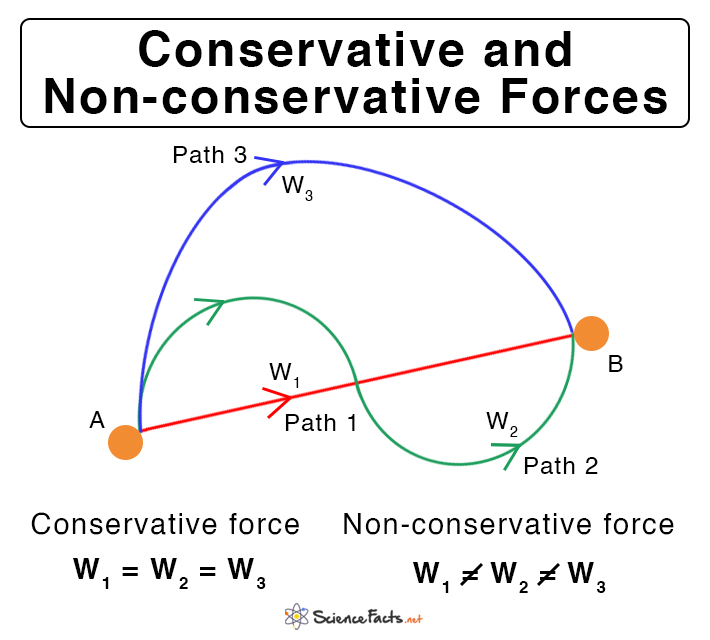
Conservative and Non-Conservative Forces
Conservative and Non-conservative Forces: Types and Examples
Conservative Force Types
Gravitational Force: Example – The attractive force between the Earth and Moon.
Spring Force: Example – The force with which a spring balance weighs fruits.
Electrostatic Force: Example – The force that holds the electrons in an atom.
Magnetic Force: Example – The force with which a bar magnet pulls iron nails.
Non-conservative Force Types
Friction: Example – The force resisting a box sliding on a floor.
Air resistance: Example – The resistance offered by air when a ball falls through it.
Fluid Friction: Example – The resistance offered by water to a submarine.
Viscosity: Example – Spreading honey over bread.
Work Done by a Conservative Force
There is stored energy associated with the conservative force. It is known as potential energy. The difference in the stored energy when the object moves from one position to another is the work done to move the object.
Suppose an object of mass m is lifted to a height h from the surface of the Earth. Then, the potential energies are:
At ground: PE 1 = 0
At a height above the surface: PE 2 = mgh
Therefore, the work done W is given by the change in potential energy.
W = PE 2 – PE 1 = mgh – 0 = mgh
Ans. The potential energy decreases when a conservative force does positive work on a body.
- References Conservative and non-conservative Forces – Phys.libretexts.org Conservative and non-conservative Forces – Montgomerycollege.edu Conservative Forces, Potential Energy, and Conservation of Energy – Courses.physics.illinois.edu Conservative Internal Forces and Potential Energy – Ocw.mit.edu Conservative Forces and Potential Energy – Texasgateway.org Conservative Forces – Real-world-physics-problems.com
Article was last reviewed on Friday, February 3, 2023


