Cilia and flagella are two cell organelles primarily found in protozoa, such as amoeba, paramecium, and euglena. However, they are also found in other microorganisms, such as bacteria, algae, and fungi, and in animals, except for higher plants.
They are motile cellular appendages made of microtubules and remain covered by the plasma membrane. Both cilia and flagella aid in movement.
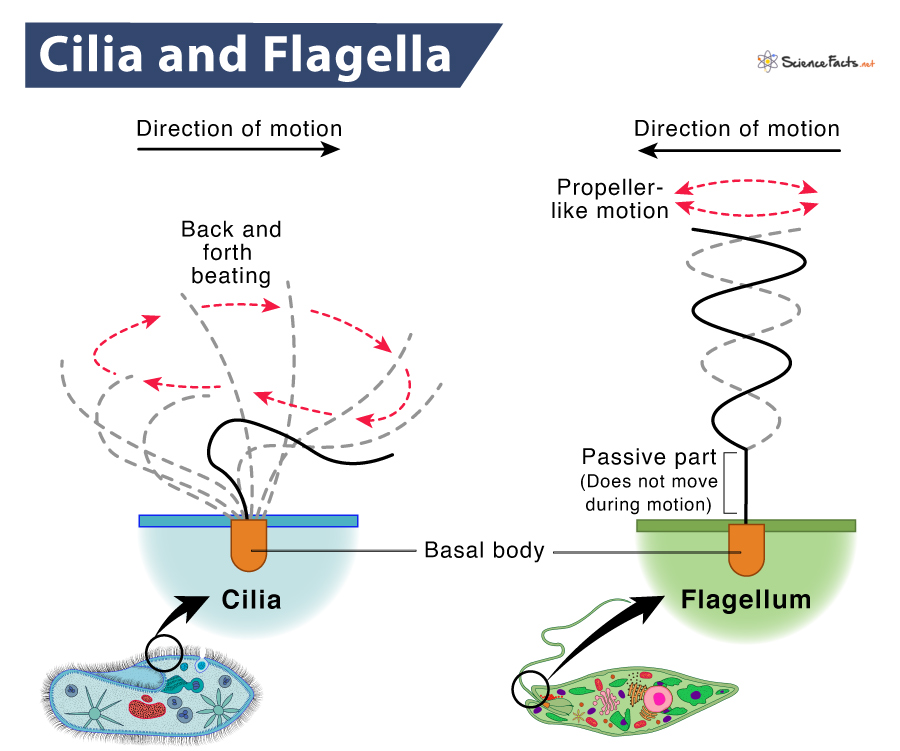
Cilia and Flagella
Compare and Contrast Cilia and Flagella
Although cilia and flagella share many characteristics, they are also different in a number of ways.
Difference between Cilia and Flagella
Cilia are short, microscopic, hair-like structures or organelles extending in large numbers from the surface of eukaryotic cells. In contrast, flagella are long, complex filamentous cytoplasmic structures protruding through the cell wall .
How are Cilia and Flagella Alike
Although they differ in many aspects, cilia and flagella have similarities. They are
- Function primarily in locomotion.
- Arise from the basal body, a centriole -like structure
- Develop from the cell’s plasma membrane
- Have an axoneme, a central filament. Axoneme has 11 microtubules, of which 9 are in pairs (doublet), and the remaining 2 are located in the center (singlet)., showing the typical 9+2 arrangement of microtubules
Conclusion
Cilia and flagella are two significant microscopic appendages of cells. Cilia are present in both animals and microorganisms but absent in higher plants. In contrast, flagella are used for mobility in bacteria and gametes (sperm and egg cells) of eukaryotes. Both cilia and flagella serve locomotory functions but in different manners. Both rely on dynein, a motor protein, and microtubules to work.
- References Flagella and Cilia – Openoregon.pressbooks.pub What Are the Main Functions of Cilia & Flagella? – Sciencing.com Cilia and Flagella – Micro.magnet.fsu.edu Cilia and Flagella: Structure and Movement – Ncbi.nlm.nih.gov
Article was last reviewed on Wednesday, February 1, 2023
